
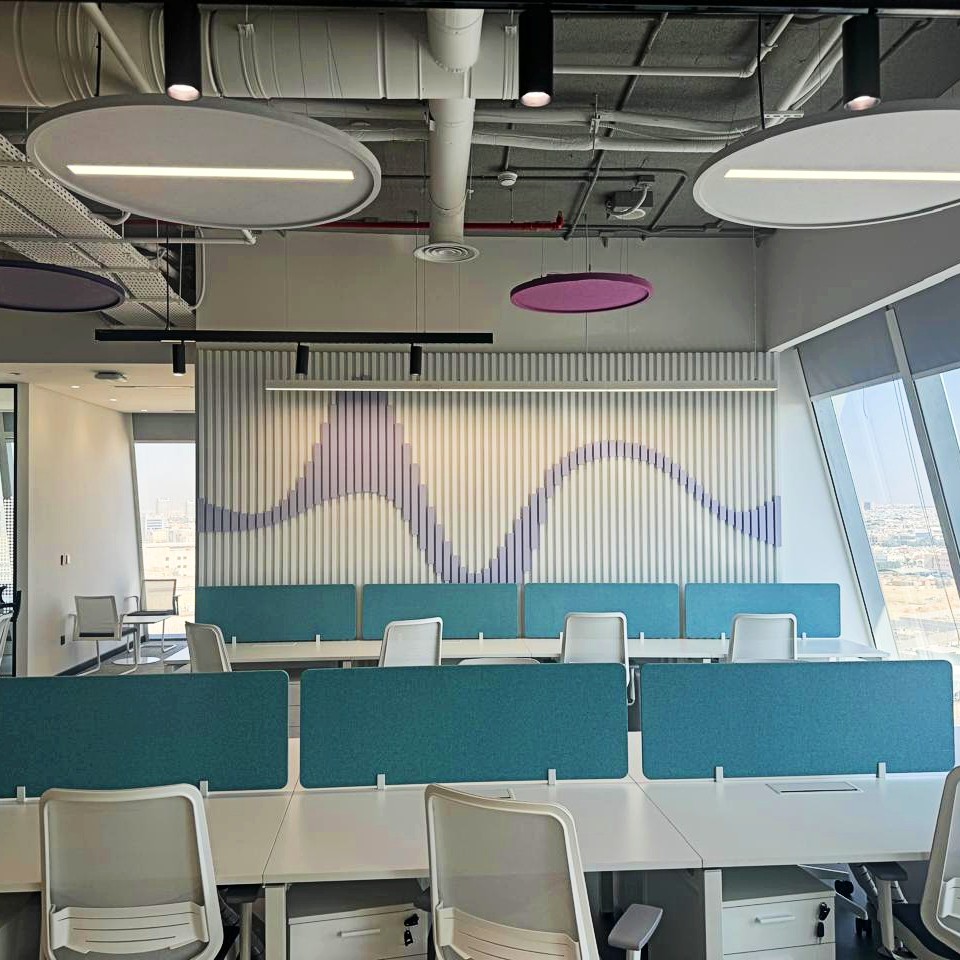
Better Office Sound Starts with the Right Acoustic Treatment
Modern offices often look impressive, but many do not sound the way they should. Open-plan layouts, glazed meeting rooms, exposed ceilings and hard floor finishes can all contribute to excessive echo and general noise build-up. Over the course of a working day, this can make an office feel unsettled, distracting and tiring for staff and visitors alike.
PET acoustic panels for offices provide a practical way to deal with these issues. They help absorb sound within a room, reduce reverberation and support clearer day-to-day communication. They also give architects and designers a flexible material that can be used across walls, ceilings, screens and suspended features without losing control of the overall fitout design.
PET Acoustic Panels for Offices – A Practical Guide for Modern Workspaces
As office design has moved towards open spaces and collaborative work areas, acoustic control has become more important. It is no longer enough for a workplace to simply look good. It must also function well for concentration, meetings, phone calls and general interaction. This is where acoustic materials play an important role.
PET acoustic panels are now widely used in commercial interiors because they offer a balance of sound absorption, visual flexibility and practical application. Whether used as wall panels, ceiling baffles, clouds or workstation dividers, they can make a real difference to the way an office sounds and feels.
Why Office Spaces Commonly Have Acoustic Problems
Many offices are filled with hard, reflective finishes. These may include glass partitions, plasterboard walls, polished concrete, vinyl flooring, joinery surfaces and exposed service ceilings. While these materials suit many modern interiors, they do little to absorb sound.
When speech and other noise reflect from one surface to another, reverberation increases. In practical terms, this means conversations travel further, background noise rises and the office begins to feel louder than it actually is. This is especially noticeable in open-plan environments where multiple discussions, movement and phone calls happen at the same time.
Common areas where this becomes a problem include:
- open-plan office floors
- meeting rooms with glazing
- boardrooms
- breakout spaces
- reception areas
- quiet rooms and focus areas
- collaboration zones
Without acoustic treatment, these spaces can become less effective for the very activities they were designed to support.
What PET Acoustic Panels Are
PET acoustic panels are made from compressed polyester fibre and are designed to absorb sound energy within a room. They are commonly specified in commercial interiors where there is a need for practical acoustic control combined with a clean and contemporary appearance.
Depending on the product system, PET panels can be manufactured in a wide range of colours, shapes, finishes and thicknesses. This makes them suitable for more than just basic wall lining. They can become part of the design language of the office itself.
Typical PET acoustic applications include:
- wall-mounted acoustic panels
- suspended acoustic baffles
- ceiling clouds
- acoustic screens and dividers
- grooved or carved decorative panels
- workstation and desk-mounted acoustic elements
This flexibility is one of the reasons PET systems are now so widely used across office fitouts.
How PET Acoustic Panels Improve Office Acoustics
PET acoustic panels work by absorbing a portion of the sound that would otherwise continue reflecting around the room. Instead of allowing speech and general office noise to build across multiple hard surfaces, the panels help control reflected sound and reduce the intensity of reverberation.
In office environments, this can support:
- clearer speech in meeting rooms
- better comfort in shared work areas
- reduced echo in glazed spaces
- lower perceived noise levels in open offices
- improved conditions for concentration and communication
It is important to note that acoustic panels are different from full soundproofing construction. Their role is to improve sound quality within a space rather than stop all sound transfer between separate rooms. For most workplaces, however, this internal acoustic control is exactly what is needed.
Wall Panels, Ceiling Baffles or Ceiling Clouds?
There is no single PET acoustic format that suits every office. The most suitable option depends on the room layout, ceiling height, furniture arrangement and the type of acoustic issue being addressed.
| Product Format | Typical Office Use |
|---|---|
| Wall Panels | Meeting rooms, boardrooms, private offices and reception spaces |
| Ceiling Baffles | Open-plan offices and areas with exposed ceilings |
| Ceiling Clouds | Shared work zones, collaborative spaces and breakout areas |
| Screens and Dividers | Workstations needing visual separation and local sound control |
In many office projects, the best outcome comes from combining more than one treatment type. Wall panels may suit enclosed spaces, while baffles or clouds deal more effectively with broader open-plan noise.
Why PET Acoustic Panels Appeal to Designers
Good office acoustics should not feel like an afterthought. Architects and designers generally want acoustic materials that do their job without undermining the look of the interior. PET acoustic panels work well in this respect because they can be used as part of the visible design rather than hidden away.
They are often available in a broad colour palette and can be manufactured in standard or custom forms. This gives specifiers greater freedom when tying acoustic treatment into a workplace’s brand colours, spatial zoning or feature elements.
For example, PET panels may be used to:
- introduce colour into open office areas
- define collaboration zones
- create suspended ceiling features
- soften hard wall surfaces in meeting rooms
- provide acoustic separation around workstations
This makes them a practical choice where both performance and presentation matter.
Environmental Considerations in Commercial Projects
Environmental performance now plays a larger role in commercial product selection than it once did. Architects, designers and contractors are often asked to consider recycled content, third-party certifications and broader sustainability requirements as part of the specification process.
PET acoustic panels are often selected because they fit comfortably within this conversation. For many projects, this makes them attractive not only as an acoustic solution, but also as a material that aligns with present-day commercial expectations around responsible product selection.
Where sustainability, acoustic function and visual design all need to work together, PET systems are often a strong option for office environments.
Choosing the Right PET Acoustic Solution for an Office
The right product choice depends on several factors, including room size, ceiling height, degree of glazing, work patterns and whether the space is mainly used for meetings, focused work or general collaboration.
In a boardroom, wall panels may be the simplest solution. In a large open-plan office with an exposed ceiling, suspended baffles or clouds may give better overall control. In workstation areas, acoustic screens may assist both privacy and comfort.
The best results usually come from looking at the office as a whole rather than selecting products in isolation. A considered acoustic plan allows the treatment to suit the way the space is actually used.
A Better Workplace Experience
Office acoustics have a direct effect on how comfortable a workplace feels. When reverberation is reduced and speech is clearer, meeting spaces work better, open areas feel more controlled and staff generally find the environment easier to use throughout the day.
PET acoustic panels offer a practical and visually adaptable way to achieve this. Whether used on walls, ceilings or as suspended features, they can help office interiors feel calmer, more functional and better suited to the needs of modern work.
Call to Action
If you are planning an office fitout, refurbishment or new commercial workspace, contact Decrasound to discuss PET acoustic panels, ceiling baffles, clouds and other sound-absorbing solutions for office environments.
Frequently Asked Questions
Are PET acoustic panels suitable for offices?
Yes. PET acoustic panels are widely used in offices because they help reduce echo, improve speech clarity and control background noise in open workspaces.
What is the difference between PET acoustic panels and soundproofing?
PET acoustic panels improve sound absorption within a room. Soundproofing is a separate construction method designed to reduce sound travelling between rooms.
Can PET acoustic panels be installed on ceilings?
Yes. PET acoustic products are commonly used as ceiling baffles, ceiling clouds and suspended panels in office environments.
Are PET acoustic panels available in different colours?
Yes. Many PET acoustic panels are available in a wide range of colours, allowing designers to coordinate acoustic treatments with interior design schemes.
Do PET acoustic panels help in open-plan offices?
Yes. PET acoustic panels can significantly reduce reverberation and speech reflections in open-plan offices, improving comfort and communication.
Explore Decrasound Acoustic Solutions
Decrasound offers a flexible range of PET acoustic solutions for offices, education spaces and commercial interiors. Explore the product range below:
Common PET Acoustic Panel Applications
| Application | Decrasound Solution |
|---|---|
| Open-plan offices | Acoustiscreen wall panels and suspended ceiling systems |
| Meeting rooms | PET acoustic wall panels for improved speech clarity |
| Exposed ceilings | Decrabaffle acoustic ceiling baffles |
| Shared collaboration areas | DecraCloud ceiling panels and PET feature elements |
| Workstations and screens | PET acoustic screens and dividers |