When Classrooms Become a Workplace Health Risk: Noise, Hearing Loss, and Teacher Safety
Classroom noise is usually discussed as a learning issue. However, for teachers, it can also become a workplace exposure issue. A busy room often runs at high noise levels for hours each day. As a result, sustained exposure can contribute to fatigue, headaches, stress, and in some cases, hearing decline.
In industrial settings, noise is measured and managed. In contrast, many classrooms lack routine monitoring, even when teachers report daily strain. When you combine hard surfaces, open layouts, glass walls and high ceilings, the room amplifies sound. Consequently, teachers often feel they are “talking over the building” throughout the day.
Reducing Classroom Noise to Support WHS, Teacher Health, and Better Learning
Why classroom noise becomes a WHS concern
A single loud event is not the main risk. Instead, the issue comes from the daily accumulation of noise, including voices, movement, furniture and corridor spill. When a room is reverberant, sound lingers and builds. As a result, students find it harder to listen, and teachers are forced to project more than they should.
- Vocal strain: teachers speak louder and for longer
- Listening fatigue: the brain works harder to filter noise
- Stress load: constant background noise becomes exhausting
- Potential hearing impact: long-term exposure may affect some staff
Common building features that make classrooms louder
Many modern learning spaces look good on paper. However, they often sound harsh in practice. If a design includes reflective finishes, noise travels further and takes longer to fade.
- Glass walls and large windows
- Open-plan learning areas with shared airspace
- Hard ceilings and minimal soft finishes
- High ceilings that increase reverberation time
- External spill noise from playgrounds, roads or flight paths
Why earplugs and headphones are not a safe long-term answer
Personal hearing protection has a role in specific situations. However, classrooms depend on clear communication and supervision. Teachers must hear students, and students must hear instruction. In addition, wearables can be uncomfortable, inconsistently used, and sometimes distracting or stigmatising.
A practical approach: reduce reverberation in the room
The most effective way to reduce noise build-up is to address the room itself. Reducing reverberation improves speech clarity and reduces the “hang time” of noise. As a result, classrooms feel calmer without changing how teachers teach.
How Decrasound PET panels support schools
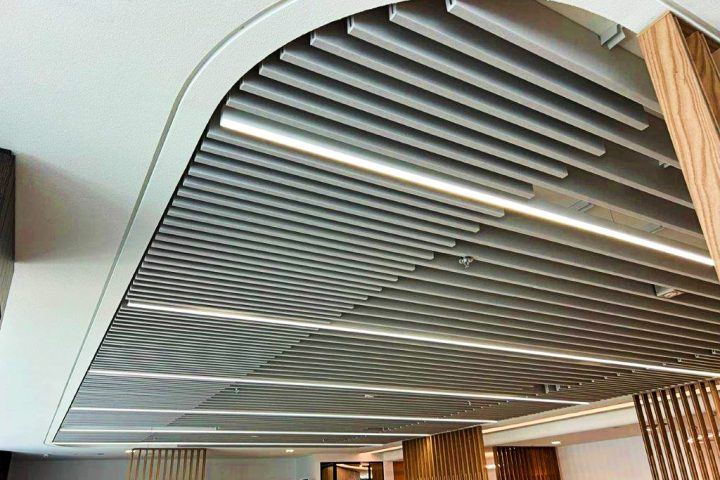
Decrasound PET acoustic panels and ceiling systems suit education settings where durability and low maintenance are important. They can be installed on walls, ceilings, baffles and screens to reduce reflections and improve speech clarity.
- Durable for schools: suited to high-traffic environments
- Flexible formats: wall panels, baffles, clouds and screens
- Better speech clarity: supports teaching and reduces repetition
- Supports WHS discussions: focuses on environmental control
- Sustainability story: PET-based solutions aligned with modern requirements
Comparison table: WHS-minded classroom noise options
| Option | What it does | Limitation | Best fit |
|---|---|---|---|
| Noise rules & routines | Reduces unnecessary noise and resets expectations | Does not change reverberation | Works best when the room already supports speech clarity |
| Wearable hearing protection | Reduces sound for one person | Affects communication and supervision | Short-term or specific tasks |
| Decrasound acoustic treatment | Reduces reflected noise across the space | Requires correct placement | Whole-school improvement |
| Building changes | Redesigns layout and finishes | Higher cost and disruption | New builds or major upgrades |
Practical steps for schools and facilities teams
- Identify “hard rooms”: spaces with glass, open layouts or high ceilings
- Start with key surfaces: ceilings and large wall areas deliver the best impact
- Document staff feedback: track fatigue and voice strain
- Consider measurement: use data to support WHS discussions
Call to action
If teachers are raising their voices all day or reporting fatigue, it is worth treating classroom acoustics as a WHS issue, not just a comfort upgrade.
Talk to Decrasound about PET acoustic panels and ceiling systems for schools. We can recommend a practical approach based on your spaces and priorities.
FAQs
Can classroom noise contribute to teacher fatigue?
Yes. Constant noise increases listening effort and voice projection. As a result, fatigue builds over the day.
Why do some classrooms feel louder than others?
Rooms with hard surfaces reflect sound. Therefore, noise lingers and builds rather than fading quickly.
Are earplugs or headphones a good classroom solution?
They can help in specific cases. However, they often interfere with communication. Treating the room is usually a better long-term option.
What is the most practical first step to reduce classroom noise?
Start by reducing reverberation using ceiling and wall absorption in the noisiest rooms.
Where can Decrasound PET panels be installed in schools?
They can be installed on walls, ceilings, baffles, clouds and screens depending on the space.